Generative AI in Compliance: Moving from Detection to Prediction
How AI transforms compliance from reactive detection to proactive prediction. Real-time risk scoring, pattern detection, false positive reduction


How AI transforms compliance from reactive detection to proactive prediction. Real-time risk scoring, pattern detection, false positive reduction

Subscribe now for best practices, research reports, and more.
Introduction
Financial services compliance operates on an outdated principle: identify suspicious activity after it occurs, report it, and learn from the incident. This reactive model no longer works in fast-moving financial markets where threats evolve faster than rules-based systems can adapt.
Leading AI-powered AML solutions now detect suspicious transactions with 96% accuracy and reduce false positives by nearly half, fundamentally transforming how institutions approach financial crime prevention. AI-driven transaction monitoring systems have improved detection accuracy by 36% in 2025 while reducing false positives by nearly half.
The Shift in Numbers:
Takeaway
The question is not whether generative AI transforms compliance from detection to prediction, but how quickly institutions adopt the shift and gain structural competitive advantage. Generative AI and machine learning models now forecast potential fraudulent activities before they fully evolve, enabling financial institutions to act preventively rather than reactively.
Static rules define traditional compliance: if transaction amount exceeds threshold, flag it. If customer accesses unusual geography, flag it. Fraudsters know these rules and build strategies to work within them.
The operational reality is brutal: rule-based systems generate false positive rates of 40-60%. Compliance teams spend thousands of hours reviewing entirely legitimate transactions. Resources diverted to false investigations cannot address genuine threats. Additionally, rules are static and lag behind threat evolution by months or quarters.
The Problem in Points:
Takeaway
Rule-based compliance is perpetually reactive, always fighting yesterday's fraud. AI does not ask whether a transaction breaks a rule. It asks whether the behaviour makes sense given what is known about the customer, the context of the transaction, and broader patterns across the institution.
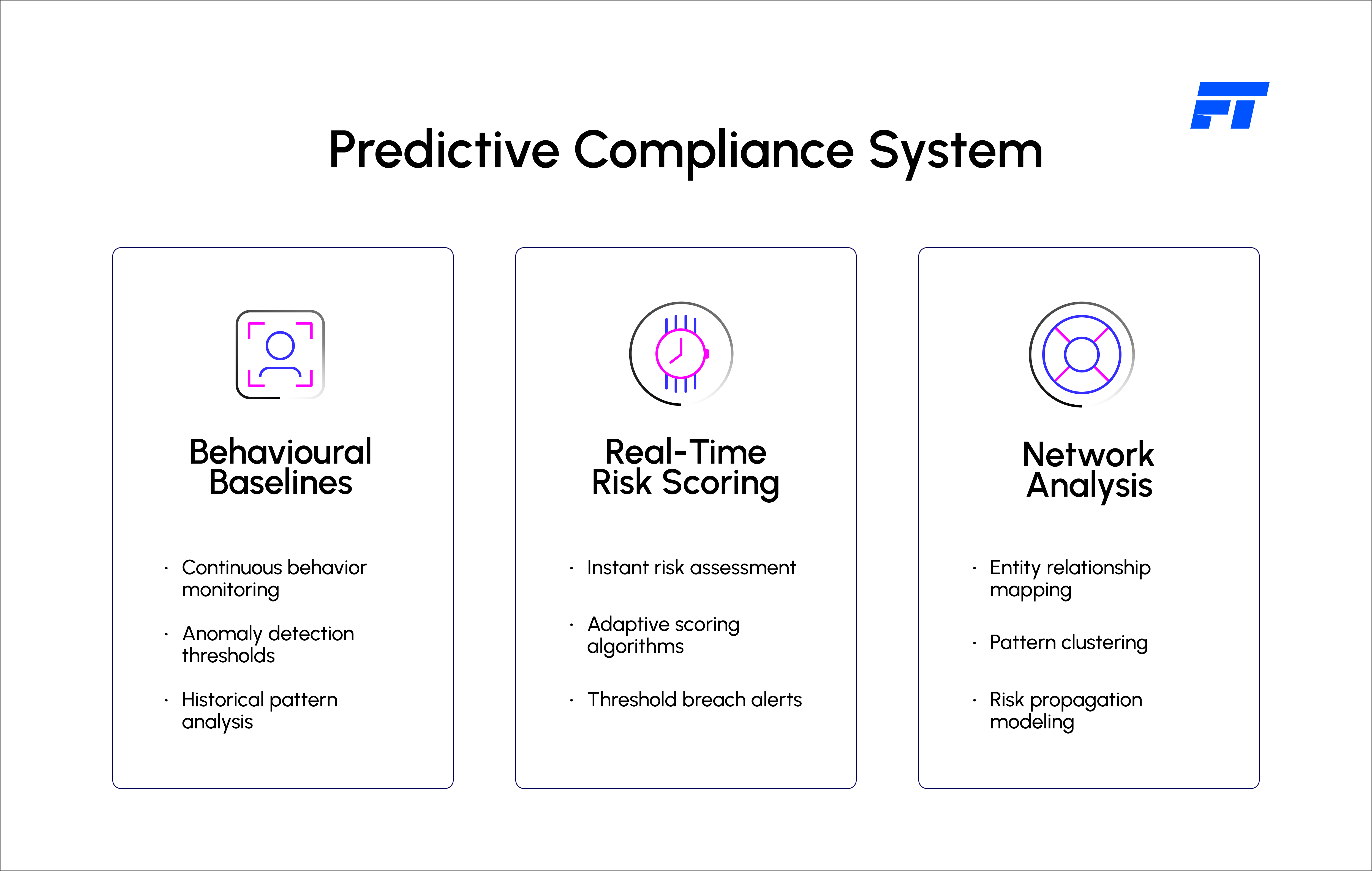
Modern predictive compliance combines three interconnected capabilities into a coherent system that continuously learns and adapts to emerging threats.
The Three Pillars:
Pillar One: Behavioural Baselines
Pillar Two: Real-Time Risk Scoring
Pillar Three: Network and Link Analysis
Takeaway
Compliance shifts from defending against known attack patterns to adapting continuously to unknown and evolving threats. The system learns. The system predicts. The system stays ahead of criminals rather than chasing them.
Predictive AI delivers three concrete operational advantages that translate directly to business impact. These advantages compound across time and scale.
Advantage One: Real-Time Risk Scoring Enables Prioritisation
Advantage Two: Pattern Recognition Detects Coordinated Activity
Advantage Three: Continuous Learning Adapts to Evolving Threats
Takeaway
Predictive AI delivers prioritisation through intelligence, network-level threat detection, and continuous threat adaptation. These three capabilities compound into structural competitive advantage.
Predictive compliance transformation addresses multiple critical business objectives simultaneously. Each benefit reinforces the others, creating compounding value.
The Six Strategic Impacts:
Takeaway
Predictive AI compliance addresses regulatory risk, operational efficiency, customer experience, response speed, competitive positioning, and long-term regulatory adaptation simultaneously.
The compliance paradigm shift is happening now. Machine learning implementation increases prediction accuracy to more than 90% compared to traditional 50-60%, representing considerable decrease in risk derived from fraudulent transactions. The evidence is compelling. The business case is mandatory.
Three Actions to Begin the Transition:
Action One: Audit Current Architecture
Action Two: Prioritise High-Volume Use Cases
Action Three: Establish AI Governance
Fyscal Partnership: Your Transformation Partner
FT helps financial institutions architect this compliance transformation. We work with you to:
We position you to move from reactive compliance to predictive compliance, from resource-intensive investigation to efficient prioritisation, from fighting yesterday's fraud to anticipating tomorrow's threats.
Ready to explore how FT can help you transform compliance from detection to prediction?

















































.png)



















.svg)