Stablecoins and MiCA Regulation: What You Need to Know in 2026
MiCA transforms stablecoins from crypto to regulated financial instruments. E-Money Tokens, reserve requirements, and cross-border implications explained.
.svg)

MiCA transforms stablecoins from crypto to regulated financial instruments. E-Money Tokens, reserve requirements, and cross-border implications explained.

Subscribe now for best practices, research reports, and more.
The stablecoin market reached $310 billion in 2025. For over a decade, stablecoins operated in regulatory grey zones. That changed on March 30, 2024, when the European Union's Markets in Crypto-Assets Regulation (MiCA) took effect.
MiCA marks the first comprehensive legal framework treating stablecoins not as cryptocurrencies but as regulated financial instruments. The regulation distinguishes two categories: E-Money Tokens (EMTs) pegged to single fiat currencies, and Asset-Referenced Tokens (ARTs) backed by multiple assets or commodities.
For issuers, MiCA means mandatory licensing, 1:1 reserve backing, and operational oversight. For users, it means consumer protection, transparency, and redemption guarantees. For the market, it means structure replacing the Wild West.
Takeaway: MiCA transforms stablecoins from experimental crypto assets into regulated payment instruments and Europe leads the global regulatory charge.
MiCA defines EMTs as crypto‑assets referencing a single official currency (e.g., EUR, USD) and explicitly states they are electronic money for the purposes of the older EMD2 directive.
What this means in practice:
Takeaway: EMTs are legally treated as e‑money running on distributed ledger technology—functionally familiar, technologically new.
A critical legal finding: stablecoin arrangements do not qualify as "payment systems" under EU law. This distinction matters for regulatory scope.
A payment system requires formal arrangements between multiple independent participants (like a clearinghouse or central counterparty). Stablecoins, by contrast, involve a single issuer and decentralised peer-to-peer transfer via blockchain. They lack the organisational and contractual structure defining a payment system.
Instead, EMTs are classified as funds the same category as banknotes, coins, and scriptural money. This means:
• Stablecoin issuers are not payment system operators
• EMTs are subject to consumer protection rules, not systemic payment infrastructure regulation
• Hybrid models (where EMTs are used for institutional settlement) may eventually require payment system oversight
• The regulatory burden is proportionate to the actual role payment instrument, not infrastructure operator
Practical Implication: By avoiding over-classification as payment systems, regulators preserved space for innovation while maintaining consumer protection.
Takeaway: Stablecoins are digital money, not payment infrastructure a legal nuance with major implications for how they are regulated.
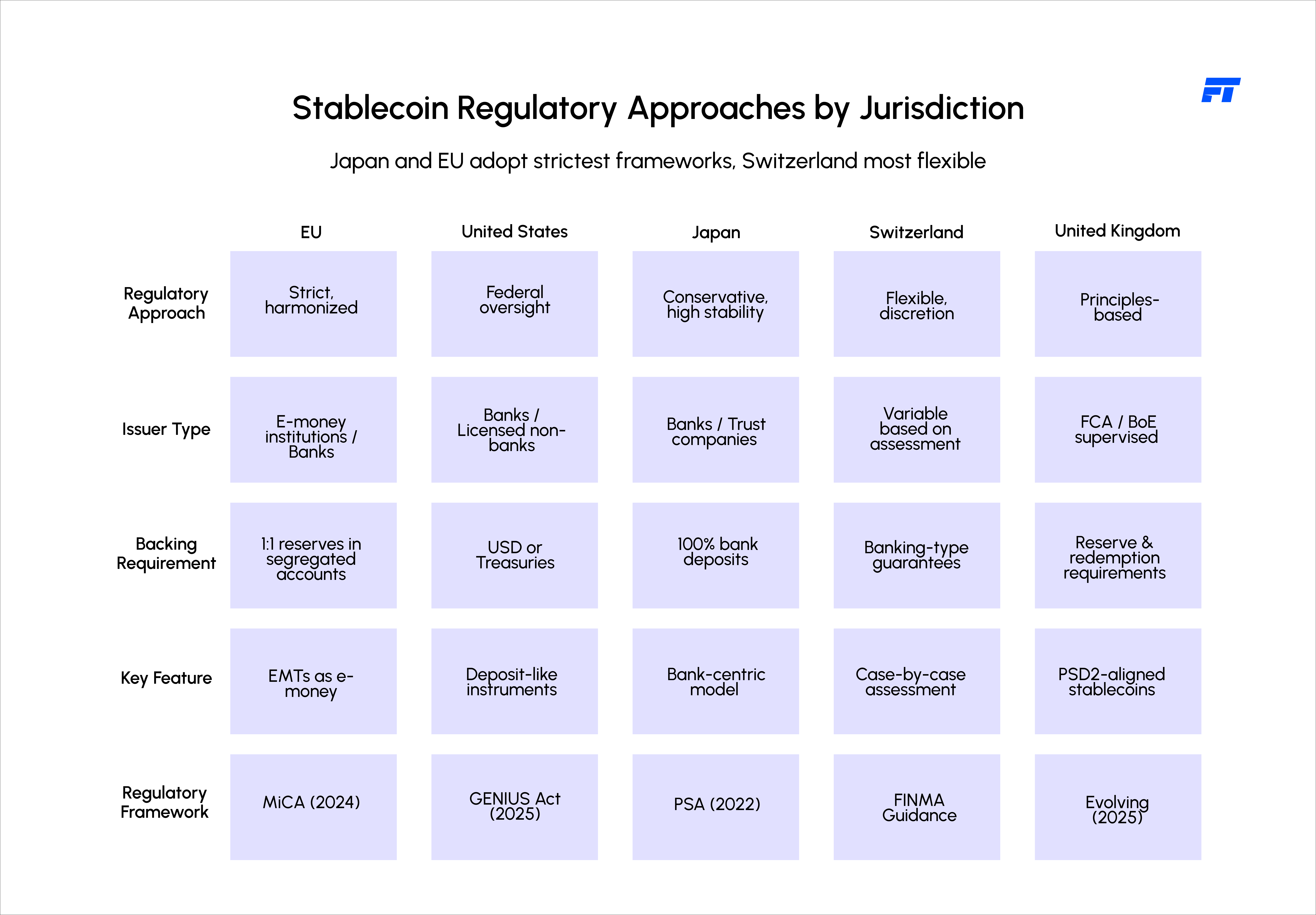
MiCA is not global law. The EU chose strict regulation; other regions made different bets. Understanding regional fragmentation is essential for global institutions.
Europe (MiCA): Most comprehensive. Exclusive licensing for credit institutions and e-money institutions. 100% reserve backing in low-risk liquid assets. Prohibition of interest. Mandatory whitepapers. EBA oversight of significant issuers (>10M users or €5B circulation). Result: Highest consumer protection, strictest issuer requirements.
United States (GENIUS Act, 2025): Federal framework. Only insured depository institutions and federally approved non-banks may issue. 1:1 reserve backing in US dollars or Treasury securities. Monthly reserve disclosure. Stablecoin holders get priority repayment in insolvency. Result: Emphasis on consumer recourse and banking law alignment.
Japan (Payment Services Act, 2022): Conservative. Only banks and trust companies may issue. 100% backing by bank deposits (recently relaxed to allow 50% in government bonds). Fewer disclosure obligations but heavy prudential focus. Result: Extreme stability but limited private sector innovation.
Switzerland (FINMA Guidance): Flexible. Case-by-case assessment. Fiat-backed stablecoins typically require banking license or equivalent guarantees. Heavy supervisory discretion. Result: More diverse models allowed, but less legal certainty.
United Kingdom (Evolving, 2025): Hybrid approach. "Qualifying stablecoins" subject to reserve backing and redemption rights. PSD2-style protections (strong customer authentication). Bank of England oversight of systemic arrangements. Result: Convergence with EU model but more principles-based implementation.
The Convergence: Despite differences, all five jurisdictions follow similar logic: extend existing payment and banking regulations to blockchain-based instruments. New regulations do not replace old ones; they layer on top. This reflects a global consensus: stablecoins are financial instruments, not speculative assets.
MiCA is reshaping the stablecoin market. Some winners are emerging; some losers are already clear.
Immediate Impact—Regulatory Exits:
Tether (USDT), the largest stablecoin by market cap, withdrew from European exchanges (notably Binance) because its issuer did not apply for MiCA authorization. USDT's reserves are reportedly held in mixed assets (not pure fiat), making MiCA compliance difficult.
Emerging Winners:
USDC (issued by Circle) obtained authorization from French regulators and is positioned as USDT's potential successor in Europe. Circle is also issuing EURC for Euro-pegged stablecoins. The market is consolidating around regulated issuers.
Market Dynamics:
US dollar stablecoins dominate 97.4% of global market cap. Euro-pegged stablecoins represent just 0.2%—500 times smaller. European banks are forming a consortium to launch a Euro stablecoin by 2026, signalling intent to challenge dollar dominance.
Regulatory Clarity as Moat:
MiCA creates a competitive advantage for regulated stablecoins. Institutions and retail users increasingly prefer regulated instruments. Compliance becomes a feature, not a burden. Those who move first to MiCA compliance gain credibility and market share.
Takeaway: MiCA winners are regulated issuers moving fast; losers are those betting on regulatory arbitrage or reserve opacity.
MiCA is not happening in isolation. Three powerful trends intersect:
Central Bank Digital Currencies (CBDCs) Launch:
The European Central Bank (ECB) plans to roll out the Digital Euro by 2025. India is testing the Digital Rupee. China's Digital RMB is in advanced trials. These are government responses to stablecoin competition central banks want to retain control of digital money.
Dollar Dominance Through Stablecoins:
97.4% of stablecoins are US dollar–pegged. The US Federal Reserve sees this as reinforcing the dollar's role as the global reserve currency. Stablecoins are, in effect, technology infrastructure for USD hegemony.
Geopolitical Realignment:
India views stablecoins as threats to monetary sovereignty and is prioritising its CBDC instead. Russia used stablecoins to evade sanctions. China sees digital yuan as a strategic counterweight to dollar-based stablecoins. This is not just regulation it is monetary geopolitics.
The Coexistence Question:
Will CBDCs and stablecoins compete or coexist? Evidence suggests both. CBDCs serve government monetary policy; stablecoins serve fast, cheap cross-border transactions. The future likely includes both, creating a hybrid financial system.
Stablecoin regulation is inseparable from central bank strategy, currency competition, and geopolitical power MiCA is one move in a larger game.
From 2014 to 2024, stablecoins operated as crypto experiments. MiCA marks the transition from experiment to infrastructure. Stablecoins are no longer speculative assets they are regulated payment instruments integrated into existing financial systems.
For institutions: MiCA compliance is mandatory but manageable. Regulated stablecoins offer competitive advantages.
For users: Consumer protection and transparency are now guaranteed.
For the market: Structure and legal clarity enable institutional adoption.
The stablecoin market will not disappear. It will mature, consolidate, and integrate into global payment systems. MiCA did not kill stablecoins it legitimised them.
Ready to navigate stablecoin strategy under MiCA?
Book a Strategy Call with Fyscal Technologies →

















































.png)